Monday, May 30, 2016

Lara Downes: "Mad Love" at Cecilia Wyatt Conservatory, Annapolis, MD, Sat. June 4, 7:30pm - 8:30pm; Masterclass Sun. June 5, 11am - 12pm, Wyatt Conservatory

Lara Downes

We asked Lara Downes what works she will play at Cecilia Wyatt Conservatory in Annapolis, Maryland on Saturday, June 4, 2016.  She graciously replied:

Actually I'm just now in the process of changing that program up to include some music from my America Again album!

The program will include:
Schumann
Debussy
Billie Holiday
Joplin
Gershwin
Thanks Bill!
Best,
L


Lara Downes will also conduct a Masterclass at Cecilia Wyatt Conservatory on Sunday, June 5, 2016 from 11am to 12pm.

ChoralNet: Auditions for The Dessoff Choirs—Malcolm J. Merriweather, Music Director


Malcolm J. Merriweather, Music Director


Audition Dates: June 6th, 7th, 9th, 6—10 PM, NOLA Studios, 250 W 54th St, NYC

2016-2017 is the inaugural season with new Music Director, Malcolm J. Merriweather, and auditions are being held for all parts.

Highlights of the season:
• Mozart’s Requiem at Alice Tully Hall with orchestra
• Take him earth, Steve Stucky
• Bach, Lobet den Herrn, alle Heiden; Jesu Meine Freude
• Jean Langlais, Messe solennelle
• David Hurd, In honor of Martin
• Lembit Beecher, A New Amorous World


Rehearsals are Monday evenings, 7—10 PM on the Upper East Side.
Audition requirements: You do not need to bring a prepared piece
• Vocalises
• Pitch memory exercise
• Sight reading
• Text Recitation (French, German, Latin)


The Dessoff Choirs is one of New York City’s leading choruses, and is known for pioneering performances of choral works from the pre-Baroque era through the 21st century.

To schedule an audition, contact: auditions@dessoff.org

For more information on The Dessoff Choirs, visit www.dessoff.org

Dr. Eric Conway, Morgan State University Choir, Day 6 in Matanzas, Cuba. I have also been asked if our concert tomorrow night could be televised across all of Cuba!


Dr. Eric Conway writes:

Day 6 in Matanzas, Cuba

After a great night’s sleep enjoyed by the entire group, we set out for another day trip today, May 29th, this time to Matanzas, Cuba.  Matanzas was a two and one half hour drive from Havana.  As we have one of the largest vehicles on the narrow Cuban streets, with every time a car that approached from the opposite direction, our driver had to slow down to make sure that both could safely pass. The Cuban lanes must be at least one foot narrower than in the US, so a 44 passenger motor coach is an enormous vehicle that almost looks behemoth in size.

We arrived in Matanzas ahead of schedule.  The word Matanzas, named by the Spanish, means massacre, due local people in the 18th century attacking a Spanish boat in the evening and killing all aboard.  Upon arriving to yet another Cuban square in Matanzas called Parque de Libertad, we immediately toured a museum like no other visited in life - a pharmacy museum.  After the quasi-interesting museum tour, we walked around the city center for an additional hour.  After taking a short stroll to purchase more internet calls at a price of $2 per hour, some of us returned to the park to purchase refreshing pina coladas, which must have been some of the best that we have ever tasted.  Later, our guide told us that he believed that the pina colada possibly originated in Cuba - with all Cuban ingredients - pineapple, coconut, nutmeg and rum.  We then drove to our group lunch a few minutes away, again with some incredible Cuban music and energy - see another clip from local musicians attached.  After lunch, we drove to a high peak outside of Matanzas, featuring one of the oldest churches in Matanzas build by the persons form Cataluna, Spain where we were able to view the entire town.  From this point, many choir members, knowing that we were in Cuba, all wanted to go to see a beach.  We drove to a local beach, just to have everyone get their feet wet, knowing that we had a concert a couple of hours later.

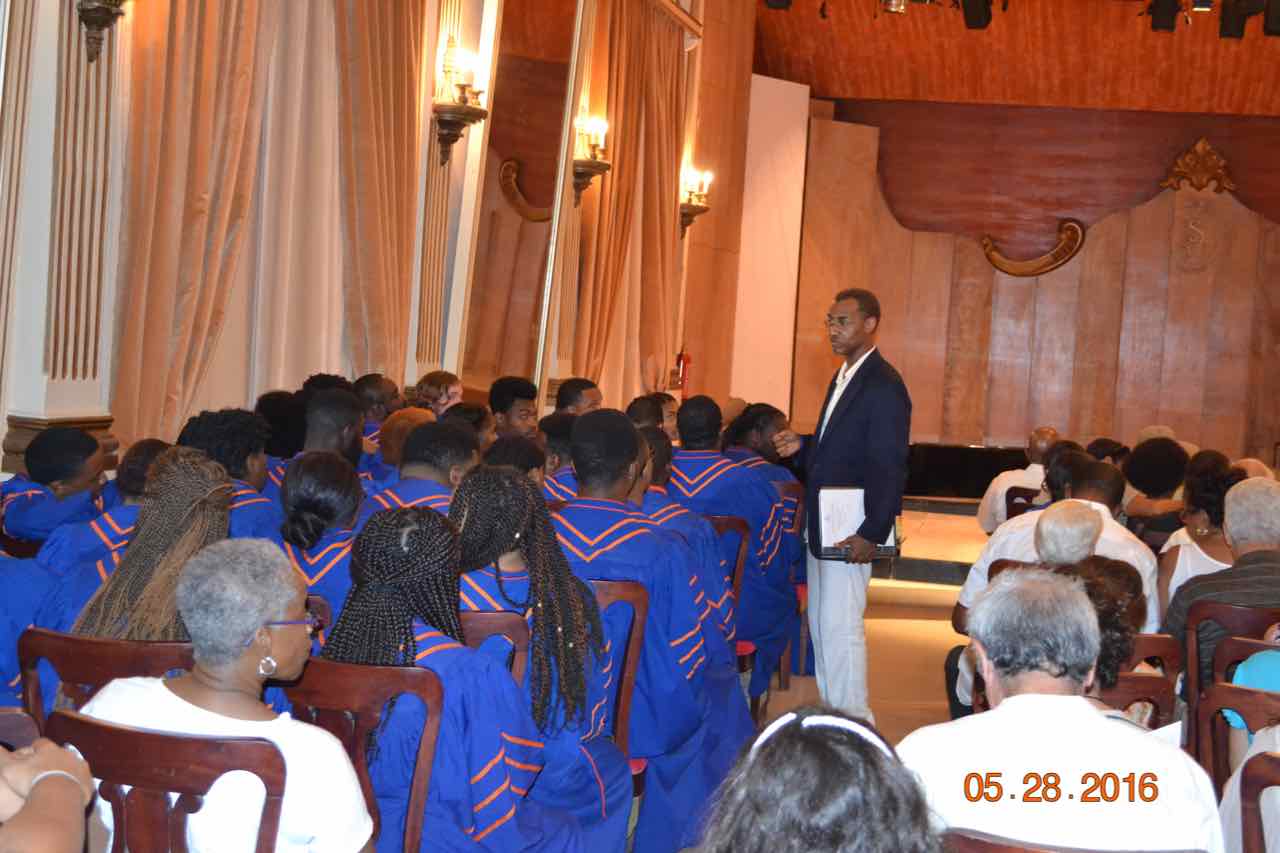
From there we went to our cultural exchange activity where we had a delightful rehearsal with a chamber group of about sixteen local choristers, who began singing a very well-known American composition by Randall Thompson, Alleluia. The Matanzas choir was very good. We were very pleased to see that the hall, although very intimate, seating only 200 or so, had air-conditioning that was stronger than any American hall.  Having the robes on the bus, we decided to again return to our choir robes for the uniform for the evening.

At 6 p.m. the concert began.  This particular concert, unlike the others, had a free admission.  The entire room was filled to capacity.  Because the room was more intimate, everyone could enjoy a better music-making experience.  Often the larger the space, the more difficult it is to control the sound, from both the audience and performance perspectives.  This evening, the sound could not have sounded better.  We sang with no amplification - went totally acoustic.  Both choirs could hear each other better on stage, and enjoy the act of singing more than with microphones.  

When the first choir sang, the the MSU choir was the most enthusiastic persons in the audience.  Subsequently, the Cuban audience wildly received the Morgan choir. Although I love enthusiastic audiences, every song that was sung this evening was so enthusiastically received that I found myself rudely interrupting their applause just to have flow to our program.  There seemed to be a genuine connection between the choirs and audience this evening - partly because the room was so relatively small, but also because both groups knew how to communicate to their music to the listeners.  

The Morgan State University Choir has made such a huge impression on the Cuban audiences, that tomorrow night’s concert venue was changed from original venue to the largest venue in Cuba.  I have also been asked if our concert tomorrow night could be televised across all of Cuba! What an impact we will have on Cuba during our tour!

More to come . . . 

EC

Sunday, May 29, 2016

Dame Myra Hess Concert Series presents Pianist Jeremy Jordan in Free Recital Wed. June 1, 2016 12:15 pm Chicago Cultural Center - Preston Bradley Hall

Jeremy Jordan

June 1, 2016 – 12:15 PM

Chicago Cultural Center – Preston Bradley Hall

78 East Washington Boulevard

Chicago, Illinois 60602

Admission: Free

Produced by the International Music Foundation, this recital will be broadcast 
‘live’ on
WFMT Radio (98.7 FM) and on www.wfmt.com

The Dame Myra Hess Memorial Concerts 
are made possible through the generosity
 of the A.N. and Pearl G. Barnett Family 
Foundation, the Peggy and Steve Fossett 
Foundation, the Paul M. Angell Family 
Foundation, the National Endowment for
 the Arts, the Sage Foundation, the Pauls 
Foundation, and the Union League Club
 of  Chicago.

Dr. Eric Conway, Morgan State University Choir: Day 5 - Travel Day to Havana from Santa Clara, Cuba - stop at the Hemingway home!


Dr. Eric Conway writes:

Day 5 - Travel Day to Havana from Santa Clara, Cuba - stop at the Hemingway home!

Today, we checked out of our Santa Clara hotel to travel to the most famous city in Cuba - Havana (Spanish: La Habana).  Who would have thought that we would have had to travel to Cuba, to commune directly with animals as we did in our Santa Clara hotel.  With the huts for rooms, beautiful pool, and wonderful buffet meals on the premises, we may have felt as though we were at a premium resort - until the entire resort would lose power, or see the number of mosquitos flying around, or smell the stench in the bathrooms.   All in all, most thought it a great adventure!

There is one matter that should be mentioned about our Cuban experience with all of our accommodations.  The Cuban infrastructure is such that their sewage system cannot handle paper.  I was explicit in telling every member of our group that we must not flush any toilet paper down any toilet in Cuba, for risk of stopping up the entire sewage system at the facility.  Given that we are creatures of habit, this was quite a difficult task to remember that after even blowing your nose with toilet paper, you must not dispose via the toilets system.  Cubans knowing this issue all too well, have waste baskets adjacent to every toilet in Cuba!  This was certainly a huge cultural difference, that we will never forget!

Today, we return to Havana, where we arrived on last Tuesday, the 24th.  We have had great but varied experiences in all the Cuban cities that we have visited thus far: Cienfuegos, Trinidad, Santa Clara, and Remedios.    It took approximately four hours to drive to Havana from Santa Clara. 

Before arriving to Havana we stopped to the Cuban residence of the great American writer Ernest Hemingway.  Hemingway purchased an extravagant residence outside of Havana in the town of San Francisco del Paulo thirty minutes from Havana.   This residence is the first residence museum of this type in Cuba!  Hemingway was thought of as "the great American!" Although we were not able to walk around the interior of the residence, we were able to peek into the residence and get a sense of where Hemingway lived, during the period of his greatest writing, including works such as: The Sun Also Rises, For Whom the Bell Tolls, and most notably The Old Man and the Sea.  It was in Cuba that Hemingway became inspired to write this great American novel.  The property was replete with palm and bamboo trees, a huge gazebo, a tall tower where he did most of his writing, and an enormous pool! We saw his personal yacht: “Pilar," docked on the property, that he took out on the water as much as he was able.

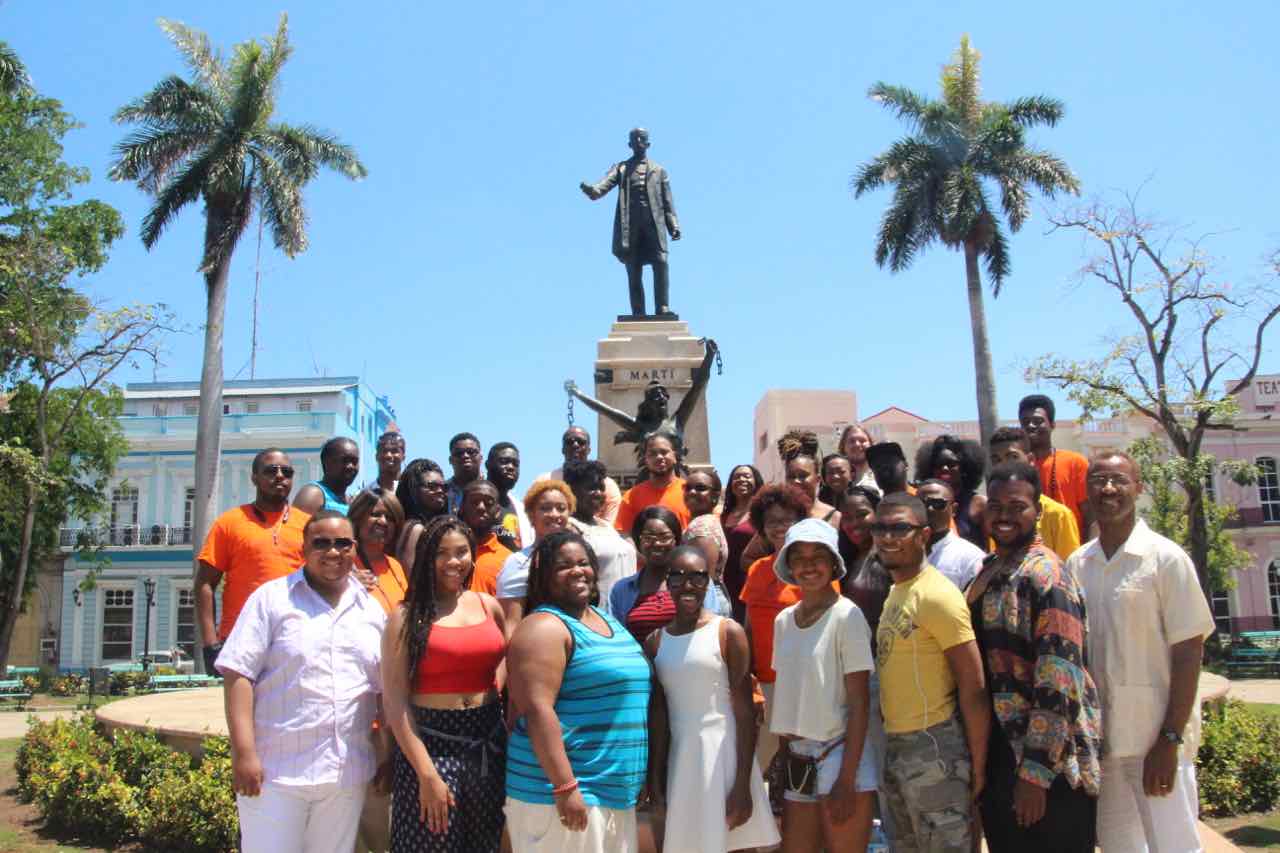
After visiting the Hemingway residence, we had a group lunch at a typically Cuban restaurant - Cafe Taberna Benny Moré.  During this very tasty meal, we again heard some great music, where the music encourage virtually everyone in the place to get up at some point and to start dancing (see video attached).  Outside of the restaurant we took our first group photo in the square adjacent to the restaurant.  After a meal is a great time to take a photo, especially if everyone enjoyed their meal.

After the meal we went to a major Havana Art Gallery:  Museo Nacional de Bellas Artes. From there, we went to the local flea market to barter for the best price for souvenirs from Cuba.  This was a huge market with over 400 separate kiosks, in a tightly organized setup.  Given the strength of the American dollar, we were able to do quite well purchasing Cuban souvenirs.

From there we went to our Havana Hotel,  Habana Libre.  Given that this was our last hotel, it was fitting that this be the best accommodations, which was not a surprise given that Havana is the most cosmopolitan city in Cuba.  This appeared to be a world-class hotel, which was probably very reasonably priced given the local economy.  

Tonight was a free evening for everyone to eat on their own and re-charge their battery.  Tomorrow we will drive three and half hours to Matanzas!

EC

Saturday, May 28, 2016

NAACP Operation Bike Week Returns to Myrtle Beach: Team Will Respond to Discrimination Complaints During Black Bike Week

Team Will Respond to Discrimination Complaints During Black Bike Week

MYRTLE BEACH, S.C. – Local, state and national NAACP officials will again be monitoring for complaints of discrimination during Black Bike Week in Myrtle Beach, South Carolina over Memorial Day Weekend.
NAACP volunteers from the national, state and local branches will be in Myrtle Beach to respond as needed to incidents, document evidence and address disputes between local business owners or police and the bikers gathering through a telephone hotline and online complaint forms.
“Being black and riding a bike should not subject you to the treatment reserved for blacks riding in the back of the bus back in the day,” said NAACP President and CEO Cornell William Brooks.  “Separate but unequal treatment is a part of our history that must not be revisited. For decades, members of the South Carolina NAACP have confronted the appalling and unfortunately common discrimination, racism and intolerance in their home state.  Our national office will always stand shoulder to shoulder with them to bring to light the hateful prejudices that override basic civil rights.”
Participants can report discrimination by local businesses online at www.naacp.org/bikeweekjustice, and can file complaints about police treatment at www.naacp.org/bikeweekarrest or call a special hotline at (888) 362-8683 to report a complaint.
This is the 10th year that the NAACP has monitored local treatment of the more than 400,000 riders who travel to the city annually on Memorial Day weekend for the largest African-American biker rally in the nation. In previous years, participants have been denied public accommodations by many businesses and restaurants and faced intense enforcement by police and public officials.
Black Bike Week is one of two major motorcycle events held near the beach town every May since the 1980s. It occurs after Myrtle Beach Bike Week rally held May 13 – 22, a majority-white bikers rally that the city hosted for decades. 
While town officials have repeatedly passed laws regulating both events, merchants and public officials have treated the two crowds vastly different. The NAACP has had to work in the past with merchants who repeatedly denied services and accommodations to black bikers by closing down for the weekend, increasing prices for goods and services, barring customers from sitting in their dining rooms and other actions. 
As a result of overly aggressive policing tactics, participants in Black Bike Week are often subjected to more arrests for minor infractions, harsh fines for local traffic and noise ordinances and other interactions with police. Town officials have a history of being openly hostile to participants, and passed numerous traffic codes, noise ordinances and municipal fines in an attempt to discourage the event.  Under negotiated settlements between the NAACP, city officials and businesses over the years, multiple businesses agreed to stop discriminating against riders while police instituted new training on crowd control and operations. 
“For years, the NAACP has fought to ensure that Myrtle Beach businesses and law enforcement do not show preferential treatment for customers based on race,” said Dr. Lonnie Randolph, president of the South Carolina NAACP State Conference. “The vast majority of bike week attendees are law-abiding men and women looking to have fun. We will be working to make sure that the city of Myrtle Beach doesn’t punish a gathering of thousands for the bad behavior of a few.” 
“This event has been the cause of unnecessary tension and restriction in this city, despite bringing millions in business and tourism to this town,” said Mickey James, president of the Myrtle Beach branch of the NAACP. “We hope that by working together, we can make this a safe and fun event for everyone.”
This year law enforcement officials will again be restricting bikers to a 23-mile traffic loop in the evening with limited exit points and have installed body cameras, automated license plate scanners, public camera surveillance and other enhancements to security.  The city imposes the 23-mile traffic loop only during Black Bike Week, the one time of the year when the majority of tourists in Myrtle Beach are African-American. 
Lawyers and field organizers with the national headquarters of the NAACP created the online reporting system and have been sent to Myrtle Beach to assist the local chapter.
###
Founded in 1909, the NAACP is the nation's oldest and largest nonpartisan civil rights organization. Its members throughout the United States and the world are the premier advocates for civil rights in their communities. You can read more about the NAACP’s work and our six “Game Changer” issue areas here.